
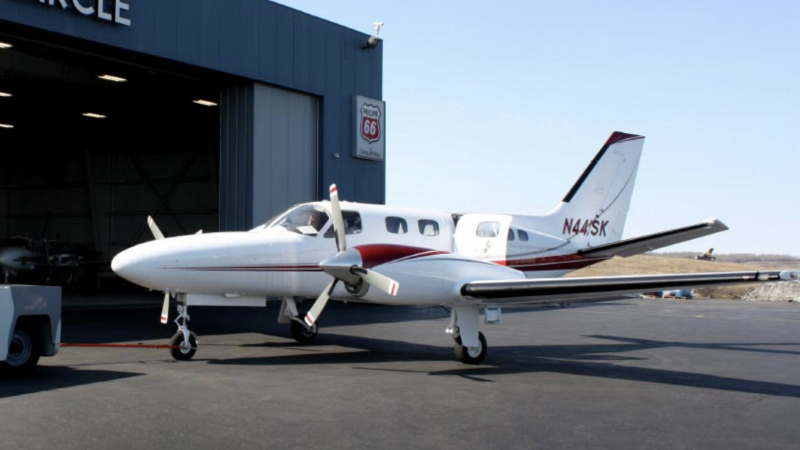
A plane charted by the US Army Corps of Engineers crashed in the fog near a remote radar site in western Alaska, killing all eight people on board, federal aviation and military officials said.
The Cessna 441 Conquest II departed Anchorage and was headed to Cape Newenham Airport, about 450 miles to the southwest, when it went down near its destination around 12:15 p.m. Thursday, the Federal Aviation Administration said, according to preliminary information.
Two pilots, two members of the Army Corps of Engineers and four contractors were on board the charter flight operated by the company Security Aviation, according to Clint Johnson, the National Transportation Safety Board’s Alaska region chief.
Search and rescue crews examined the wreckage and determined there were no survivors, the Air Force said.
The Cessna crashed at Cape Newenham Airport, an Air Force airstrip that provides access to a Long Range Radar Site, the Air Force said in its statement. Only military and approved charter flights are allowed to land at the facility. The radar is part of a military early warning network that monitors aircraft along the borders of Alaska’s airspace and is maintained by military contractors.
“This is a devastating loss for our military family and the communities we serve,” said US Air Force Lt. Gen. Robert Davis. “These individuals were dedicated professionals carrying out a vital mission in a demanding environment.”
The US Army Corp of Engineers’ Alaska District said it was aware one of its chartered flights crashed and that two USACE employees were among the victims, it said in a statement.
The names of the passengers and crew will be released after next of kin have been notified, the Air Force said.
A preliminary NTSB review of radar and air traffic control data on Friday shows the pilots made at least one attempt to land but were not able to, so they circled and tried again, Johnson said.
“There was at least one approach that was attempted,” Johnson said. “It ended in a missed approach. (The plane) went back, held for a while, and then started a second approach. And that’s when the accident happened.”
It was foggy at the landing strip around the time of the crash, according to observations from the National Weather Service. Just before noon the visibility was reported at less than 800 feet.
Due to the bad weather, the pilots were relying solely on the plane’s instruments, including the GPS, for reference as they prepared to land on the south runway, Johnson said.

After the pilots aborted their first attempt to land, air traffic controllers lost contact with the plane, he said. Controllers were later notified it did not make it to the airport.
The gravel runway is nearly 4,000 feet long and is located on the slope of a more than 2,300 foot high mountain, according to FAA maps. There is high terrain reported on both sides and at the south end of the runway, which can make aborting a landing improbable after a certain point.
The wreckage, Johnson said, is about a third of a mile to the west of runway 15, in an area of rising mountainous terrain.
The FAA and the National Transportation Safety Board will investigate what happened. The NTSB will lead the investigation and typically takes one to two years to determine the probable cause of a crash.
“Our hearts go out to the families, friends and loved ones of those who were lost,” Security Aviation said in a statement. “We will not speculate about the circumstances or potential cause and will defer questions regarding the investigation to the agencies leading that work.”
A six member NTSB accident investigation team is on its way to Cape Newenham, Johnson said, a logistical challenge because of how remote the accident site is.
Alaska Sen. Lisa Murkowski expressed her condolences in a statement on X.
“I’ve traveled extensively with Security Aviation throughout Alaska, and have met many of their experienced pilots,” Murkowski wrote. “I appreciate the U.S. Coast Guard, NTSB, Alaska State Troopers, and the Rescue Coordination Center for responding to the site. Alaska is praying for those on board, their loved ones, and the team at Security Aviation.”
On its website, Security Aviation said its “fleet of Cessna Conquests are ideally suited for flights in Alaska with challenging weather and airport environments.”
The twin-engine turbo-prop aircraft are pressurized, seat up to nine passengers and have the ability to cruise at 330 mph at 28,000 feet, Security Aviation says.
This story has been updated with additional information.


