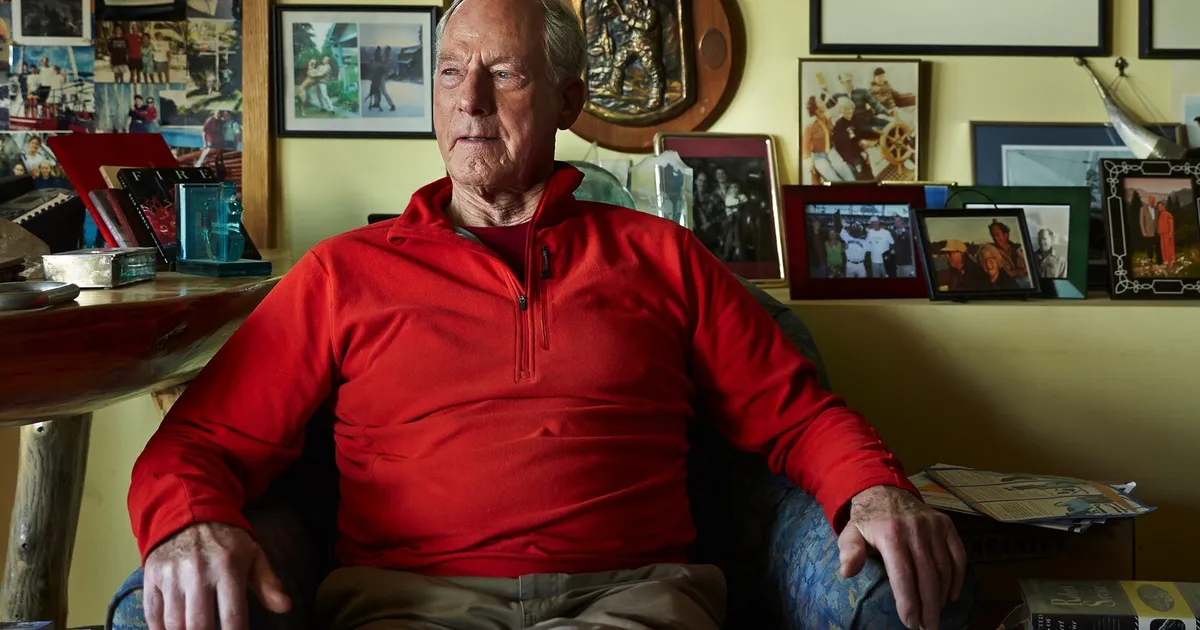
Jim Whittaker, a Seattle-born and -raised mountaineer who achieved legendary status when he became the first American to summit the world’s tallest peak in 1963, died Tuesday in Port Townsend at the age of 97.
Cascadia Daily News reported Whittaker’s death in an obituary published Wednesday morning.
Whittaker reached the top of Mount Everest on May 1, 1963, alongside Nawang Gombu Sherpa, drawing on years of formative climbing experience forged in the Cascades. His historic ascent, a decade after Edmund Hillary and Tenzing Norgay, earned him and his American Everest Expedition teammates the National Geographic Society’s Hubbard Medal. In 1978, Whittaker led the first successful U.S. expedition to K2, the world’s second-tallest peak, and set a record for the most successful Everest expedition in 1990.
Even beyond his exploits on mountains across the globe, Whittaker’s life is the subject of outdoors folklore. He was the first full-time employee at REI and eventually became its CEO. In retirement he sailed around the world with his two youngest sons.
“Whether at home, in the mountains, or at sea, he sought to share adventure, joy, and optimism with those around him,” the Whittaker family said in a statement. “His warmth, humility, and belief in the power of nature to bring people together left an enduring legacy of care for our planet and for one another.”
Seattle’s mountaineer
Whittaker and his twin brother Lou were born Feb. 10, 1929, and raised in West Seattle’s Arbor Heights neighborhood. The siblings began climbing in the early 1940s as part of the Boy Scouts, the Explorers climbing group and The Mountaineers. Jim enrolled in The Mountaineers Basic Climbing course in 1945, the beginning of an 82-year membership in the Seattle-based outing club.
“I’m forever grateful to those brave volunteer instructors who were willing to welcome a stumbling teenager into their course and teach me about gravity,” Whittaker said, as quoted in a tribute published Wednesday afternoon by The Mountaineers.
Whittaker credited The Mountaineers for introducing him to mentorship figures from Washington’s climbing community like REI founder Lloyd Anderson, mountaineer and environmentalist Wolf Bauer, and climbing ranger turned artist and author Dee Molenaar.
Jim and Lou were quick studies; they began guiding climbers on Mount Rainier, taking over management of the national park’s guide service in 1949, according to The Mountaineers. Lou, who died in 2024, co-founded Ashford-based Rainier Mountaineering, Inc., the guide outfit that leads the most clients annually up Washington’s tallest peak.
When he wasn’t guiding, Jim studied at Seattle University and sold ski equipment. Both brothers were drafted by the U.S. military during the Korean War, when they leaned on their Rainier experience and taught high-altitude and winter survival skills to 10th Mountain Division soldiers at the Army’s Mountain and Cold Weather command in Camp Hale, Colo.
After an honorable discharge in 1954, the siblings came back to Seattle and Jim returned to his job selling ski gear. The next year, Anderson hired him as the first full-time employee of REI, then still a fledgling cooperative opening its debut store.
Despite the requirements of managing a retail outpost, Jim found time to steal away and guide clients — including a 1961 expedition with his brother at Mount McKinley, also known as Denali, that went awry, stranding the team above 17,000 feet for four days.
Jim and Lou emerged unscathed, and their grace under pressure helped earn them invitations to the 1963 American Everest Expedition. According to HistoryLink, Lou trained alongside Jim but ultimately declined a spot on the team because he was opening a sporting goods store in Tacoma. “I felt betrayed,” Jim wrote in his autobiography, “A Life on the Edge,” published by Mountaineers Books in 1999. “It was a stunning blow.”
Becoming the first
Jim ended up proving instrumental, as his REI experience enabled him to organize and ship loads of gear for the four-month attempt. While even a modern Everest climb is not a walk in the park, Whittaker’s era entailed a true expedition undertaken at a time before the infrastructure of mass climbing tourism, like intricate fixed-rope systems installed by Sherpa teams.
After weeks of hauling gear and establishing base camps, Whittaker found himself pinned down at 27,300 feet in Camp 6 alongside expedition leader Norman Dyhrenfurth and two Nepalese guides. With supplies and oxygen running low, the American climbers decided it was “a sort of now-or-never situation,” Whittaker told The Seattle Times in 1983.
Their summit bid began at 6 a.m. in strong winds, blinding snow and minus 35 F temperatures. Dyhrenfurth couldn’t match Whittaker’s pace and turned back after an hour, leaving the final push to Whittaker and Gombu. The cold seeped through Whittaker’s mask and frostbite nipped at his cheek. An eye swelled shut. But the weather broke long enough to see the ridgeline to the main summit. That omen propelled them forward “because you feel you have to get it, you don’t even think about turning around,” Whittaker said.
Seven hours into their trek, the duo reached the summit. With their oxygen dwindling, they spent only 20 minutes on the roof of the world — long enough to plant an American flag and take the requisite photos. An enduring image shows Whittaker in all his glory: red parka, blue insulated pants, the Stars and Stripes wrapped around his ice ax.
Whittaker’s son, Leif, himself an accomplished guide and high-altitude climber, appreciated the magnitude of his father’s accomplishment on one of his own Everest climbs in 2012.
“I was sitting at the South Summit at about 300 vertical feet from the top and looking at the Hillary Step, I had this vision of my dad and Nawang Gombu Sherpa climbing up there,” he told Cascadia Daily News.
“It’s 50 years earlier and I imagined what that was like without the fixed ropes, without the crowds. Just those two with a single rope connecting them and ascending this incredibly challenging terrain through a storm no less.”
From anonymous climber to national hero
The team’s successful summit bid — four climbers in addition to Whittaker and Gombu made it to the top on May 22 — made rock stars out of the mountaineers in an era of national rivalries like the Space Race.
“Back then, everyone paid attention to these climbs,” high-altitude climber Ed Viesturs, a member of Whittaker’s 1990 International Peace Climb on Everest, told REI’s Uncommon Path. “It was a very nationalistic thing. … The president took notice.”
President John F. Kennedy made a short speech the next day, though at the time Whittaker’s name had not been made public as the successful summit climber. While the expedition consisted of 19 Americans and six Sherpas, in a culture that celebrates firsts — from John Glenn to Neil Armstrong — Whittaker’s feat made him the face of the climb.
According to HistoryLink, Whittaker‘s photo was on the covers of Life and National Geographic magazines. The Seattle Times named him state newsmaker of the year.
He returned to Seattle, where the local boy made good was feted with a downtown parade June 24. The next week, Kennedy presented Whittaker and his teammates with their Hubbard Medals in a White House ceremony.
When the Canadian government named unclimbed 14,000-foot Mount Kennedy in the slain president’s honor, National Geographic tapped Whittaker to lead an expedition — and the president’s brother Sen. Robert F. Kennedy was one of the team members.
Whittaker met Kennedy in Seattle in March 1965 and the team headed to the Yukon. When they reached the summit, with RFK given the nod to take the first step at the top, Whittaker wrote in his memoir, “Tears rolled down my cheeks and froze on my parka.”
(The emotional climb, recreated by Kennedy and Whittaker descendants 50 years later, was the subject of the 2018 documentary ‘Return to Mount Kennedy.’)
After their experience on a rope team, Whittaker and Kennedy became close friends. The Seattle mountaineer who stocked shelves at REI became a regular guest at the Kennedy family home in Virginia and vacationed with the Kennedys in Sun Valley. Whittaker became Kennedy’s Washington state campaign manager during his 1968 run for president and rushed to Los Angeles when assassin Sirhan Sirhan shot the senator in a hotel ballroom. Whittaker was at Kennedy’s bedside when he died and served as a pallbearer at his funeral.
K2 ambition
Public life coincided with professional advancement. Whittaker’s Everest climb generated major publicity for his employer, REI, and the coop grew considerably. On Jan. 1, 1971, Anderson retired and named his longtime general manager the new CEO.
Those demands, plus the time commitment of climbing expeditions, strained Whittaker’s first marriage to Blanche Patterson, who he met when she worked at the Paradise Inn at Mount Rainier. The couple had three sons together — Carl, Scott and Bob (named for Kennedy) — but divorced in 1971.
Whittaker married Dianne Roberts, an outdoors photographer working for Parks Canada, in 1974, and had two more sons, Joss and Leif. Roberts became part of his next ambition, leading the first US team to the top of K2, the world’s second tallest peak but widely considered a much more difficult climb.
Lou joined the 1975 expedition, which failed after five weeks due to a combination of bad weather, disagreements with porters, avalanche risk and poor team dynamics. Jim’s brother did not come on the successful 1978 return attempt — while the twins stood atop Rainier dozens of times, they never shared a Himalayan summit.
Although Whittaker grew REI into a $46 million enterprise with hundreds of thousands of members during his eight-year tenure as CEO, he became dissatisfied with the sedentary nature of an office job and retired in 1979.
Whittaker embraced his retirement passion, sailing, and moved with Roberts and their young children to a 35-acre lot in Port Townsend in 1985. The retired outdoorsman suffered a financial blow when his business partner falsified invoices at Whittaker-O’Malley, Inc., an outdoor equipment manufacturing company, forcing him to sell a portion of the blufftop property. He later recovered some of his losses when he became chair of the board for Magellan Navigation.
In 1996, Whittaker, Roberts and their two sons embarked on a four-year, 20,000-mile sailboat journey around the Pacific.
Golden years
Whittaker’s final summit-oriented Himalayan expedition was a fitting coda to the nationalism inherent in his first climb. In 1990 he organized the International Peace Climb, which recruited mountaineers from rival superpowers China, the US and the USSR. Whittaker traveled to both countries in order to secure permission for Soviet climbers to enter Chinese-controlled Tibet. Sen. Edward Kennedy, in a forward to Whittaker’s autobiography, called him “our first high-altitude diplomat.”
Whittaker eventually assembled a 30-person team that put a landmark 20 climbers on the summit — at the time the most successful Everest expedition ever.
“Jim Whittaker’s leadership was the glue that held our expedition together,” Viesturs, at the time a Seattle-based climber, wrote in 2006.
By this point, Everest was already becoming loved to death. Whittaker and his teammates celebrated Earth Day by removing or burying some two tons of garbage from previous expeditions. That kind of ethic harked to Whittaker’s days in the Boy Scouts and also imbued the way he used his voice in the twilight of his career.
Mountaineers CEO Tom Vogl recalls Whittaker attending a 2019 ceremony at Gas Works celebrating the permanent reauthorization of the Land and Water Conservation Fund. “I always found it inspiring that Jim showed up to advocate for public land,” he told The Seattle Times. “His accomplishments were a source of great pride for people who love mountains and love climbing.”
While Whittaker at first hesitated over the attention — “I was given keys to the city,” he wrote in his memoir. “I kept thinking, ‘Look, all we did was climb a mountain.’” — he eventually settled more comfortably into a role that made him one of the great elder statesmen of American climbing.
“I have discovered that individual and communal learning takes place when we find ourselves at the edge of our comfort zone,” Whittaker said. “Being out on the edge is where we learn and grow the most.”
This breaking news story will be updated.
Comments on this story were turned off in accordance with Seattle Times policy.